
Identity Fraud Trends in 2025: Document Fraud, Imposters and Emerging Threats

At the heart of thousands of verification processes we complete for our customers every day is an identity document check: confirming that the document being presented is genuine and belongs to the holder.
Today, we are the UK’s leading provider of Right to Work checks, putting that verified identity into a compliance process which meets the latest Home Office standards. In our wider position as identity experts, we also have visibility across a broad range of customer use cases, from compliance to counter‑fraud and beyond, giving us a clear perspective on how document fraud is evolving in the real world. In this annual round‑up, we draw on fraud statistics from across our customer base and explore the key fraudulent document trends we saw emerging throughout 2025.
How the Identity Fraud Threat Evolved in 2025
Fraud prevention remained a major focus in the UK during 2025, reflected in the introduction of the ‘Failure to Prevent Fraud’ offence and continued enforcement against illegal working. For our customers, the threat has been equally clear.
Since 2023, we’ve seen a shift in the types of fraudulent attempts detected. Tighter guidance and the Digital Right to Work Scheme, which reduced the range of documents fraudsters could present, coincided with a slight drop in fake documents and a narrowing of document nationalities. However, fraud did not decline overall. In 2025, we saw renewed growth in fraudulent documents and a rise in wider tactics, particularly imposter fraud and digitally altered documents.

Fraudulent Identity Document Trends in 2025
Our expert identity team saw fraudulent identity documents increase by 72% in 2025 compared to 2024, based on data from TrustID customers using our services for Right to Work and other compliance checks, as well as wider onboarding scenarios such as student enrolment, Director checks and Know Your Customer processes.
Fraudulent passports: the most common identity document fraud
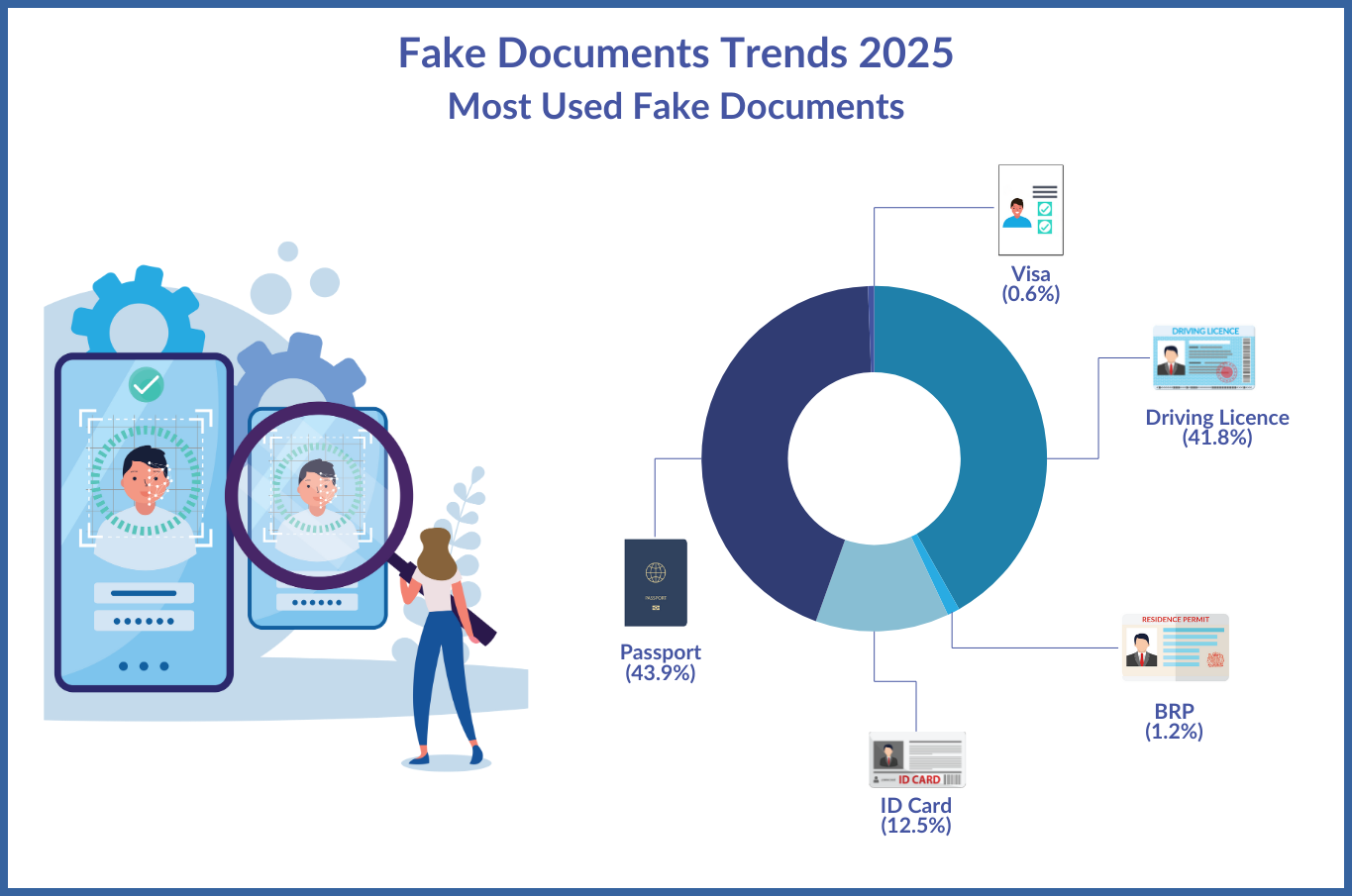
Fraudulent passports were the most common form of identity document fraud in 2025, with British and Irish passports appearing most frequently for the third year running. Successfully presenting these documents allows the holder to gain work, access services or rent a property without needing a follow‑up check.
Driving licence fraud and the limits of visual checks
Fraudulent driving licences also featured highly. While not acceptable for demonstrating Right to Work eligibility, they are widely used in other verification scenarios, including Companies House Director checks or as supporting evidence in DBS checks. Driving licences are easier to counterfeit than passports due to simpler materials and fewer embedded security features. As a result, many counterfeits are convincing enough to pass visual checks, highlighting why robust, technology‑supported verification is essential.
Fraudulent identity documents by claimed country of origin
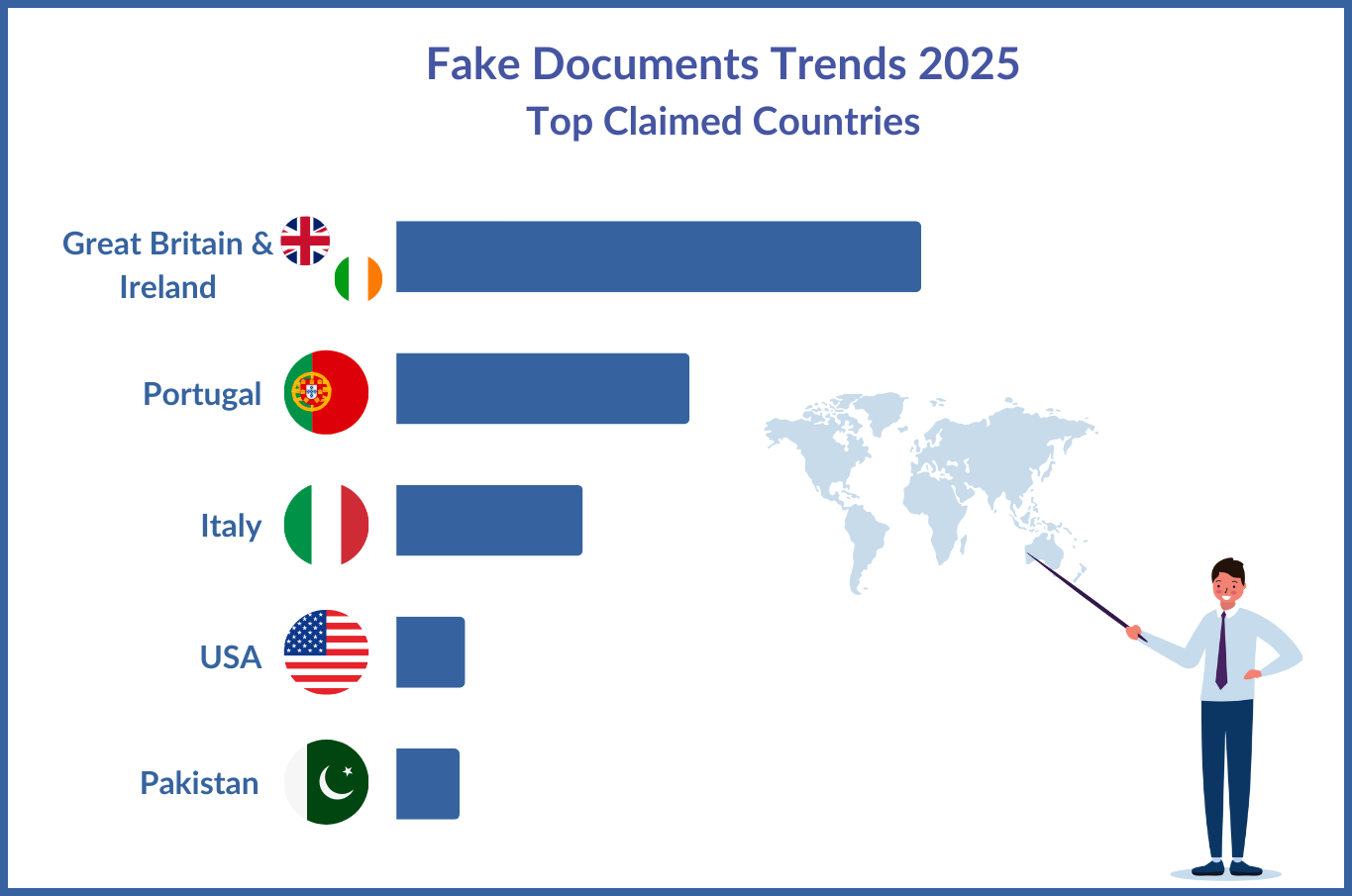
In 2025, our customers encountered fraudulent documents claiming to originate from more than 50 countries, the widest range we’ve ever recorded. We also saw a surge in Italian, Portuguese, American and Pakistani documents, none of which had previously appeared in our top five. This growing diversity makes manual verification increasingly unrealistic. Advanced validation technology is now essential for accurately identifying such a broad spectrum of document types. By using our services, customers benefit from a powerful blend of cutting‑edge technology and expert human review, eliminating the need for constant internal retraining and ensuring consistent, reliable fraud detection.
Emerging Identity Fraud Tactics Beyond Fake Documents
As the above data shows, our customers continue to encounter fake identity documents, but high‑quality counterfeits remain expensive and technically difficult to produce. As a result, fraudsters are increasingly shifting toward lower‑effort, lower‑cost methods. Instead of relying solely on fully fabricated documents, we are seeing a rise in digitally altered images and a continued trend in imposters. These tactics are easier to execute and harder to spot without technology‑led checks. As more organisations move to digital onboarding and remote verification, robust identity document validation technology (IDVT) is becoming an essential tool to help them detect these emerging forms of fraud.
Imposter fraud: using genuine documents and share codes
Imposter fraud occurs when an individual presents a genuine identity document or share code that does not belong to them. Because the document itself is legitimate, imposter fraud is harder to detect without biometric face matching or identity verification technology. Since 2023, we’ve been tracking a growing trend in imposters. The number of imposters identified by our customers in 2025 was similar to 2023, with a 50/50 split between document and share‑code imposters. In some cases, the same share code was presented multiple times by different applicants, suggesting a trade in share codes to facilitate illegal activity.
Digitally altered identity documents and AI-driven fraud
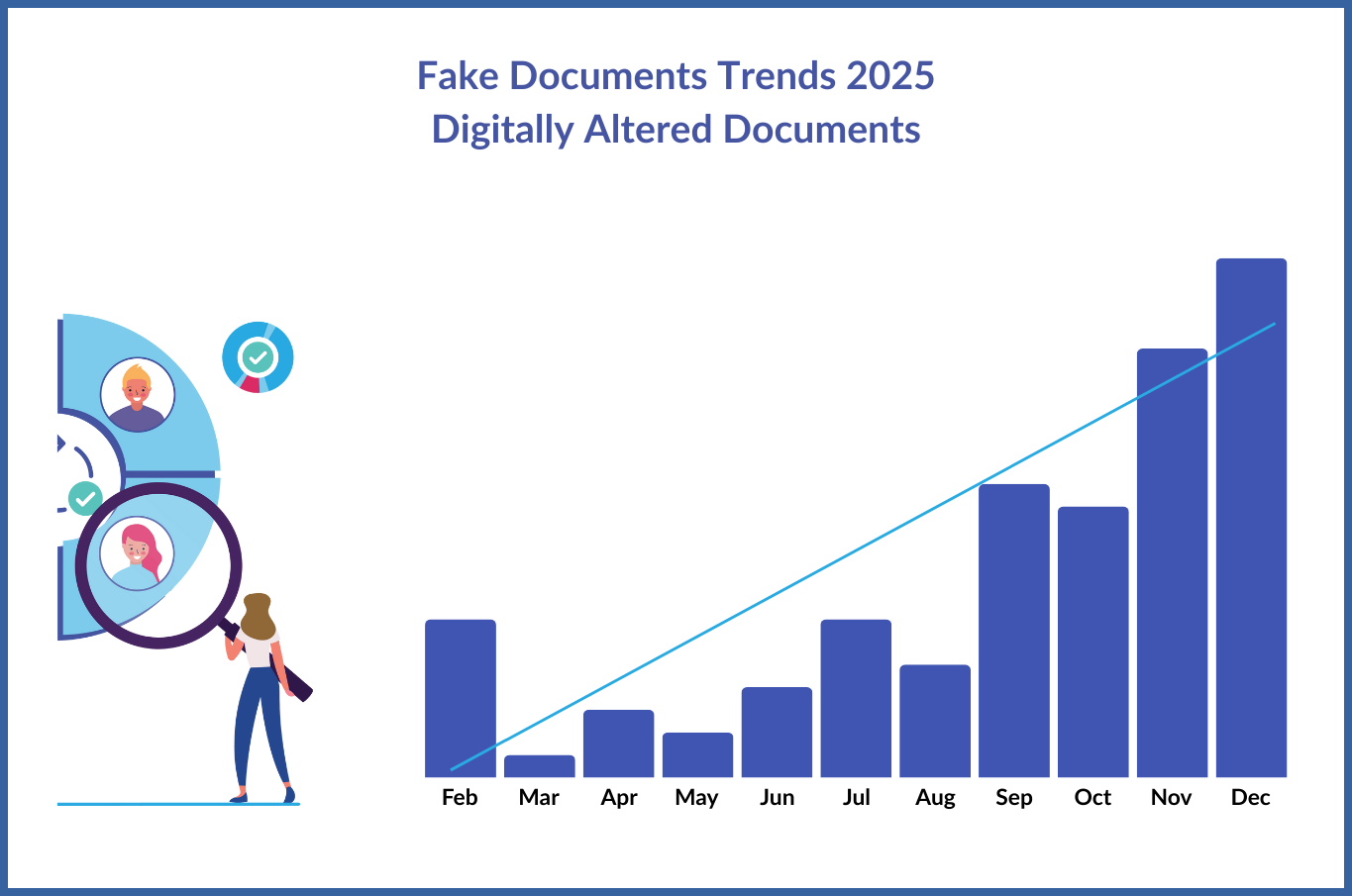
A newly emerging trend in 2025 was an increase in digitally altered identity documents. Data and intelligence from Cifas shows that criminals are using advanced AI to create fake identities, forge documents and bypass verification systems with alarming accuracy. Our statistics reflect this, with a stark rise in digitally manipulated documents presented to our customers. In many cases, the photograph of the genuine holder or the text within the document had been altered. Our team has noticed that the quality and sophistication of these documents is increasingly high and may be difficult to spot with the untrained eye.
This increase in digitally altered identity documents is expected to persist, as advancements in AI technology and its widespread accessibility have significantly lowered the barriers to document fabrication, removing the need for extensive technical expertise, or specialist networks.
How Technology Helps Detect Identity and Document Fraud
Technology helps combat identity fraud by combining document validation, biometric analysis and human expertise to confirm that an ID is genuine and belongs to the person presenting it. Our customers benefit from a dual defence against these latest trends. The technology behind the TrustID service performs multi‑layered analysis to spot inconsistencies and signs of digital manipulation. This includes checks on font consistency and security elements such as holograms and microprint, as well as ensuring the physical document is present during capture. Applicants are also asked to take a selfie, after which the system conducts real‑time biometric analysis and matches the photo to the ID to confirm that the user is taking a live image and is the rightful document holder. This technology‑led approach is supported by a team of human experts who are continually trained in document and facial‑match analysis and stay on top of emerging trends.
Identity Fraud Trends to Watch in 2026
The patterns we saw throughout 2025 suggest that identity fraud will continue to evolve in 2026. AI‑driven document manipulation is likely to increase, with convincing edits to photographs, text and security features making technology‑supported checks essential. Alongside this, imposter attempts will remain a significant threat as fraudsters continue to exploit gaps in digital‑status processes, reinforcing the need to match the person to the identity, not just the credential.
As fraud tactics continue to evolve, organisations need identity verification they can rely on. Whether you’re looking to improve compliance, protect against emerging threats or streamline onboarding, TrustID can help you stay ahead with technology‑supported checks backed by expert human insight. If you’d like to understand how these trends relate to your organisation or explore how our services can support your verification processes, our team would be happy to talk.
If you liked that, you might like this..

Trends in Fraudulent Identity Documents in 2023
Tony Machin
January 15, 2024
At TrustID, we constantly monitor and record the number and type of fake identity documents we detect across different industries. Take a look at our 2023 analysis to learn about the type of documents and sectors are most at risk from illegal applicants.

2 years of Digital Scheme checks
Sarah Croft
January 9, 2025
Read our free guide to explore what’s changed for employers in the 2 years since the introduction of the Digital Scheme, including fraud trends, a look at the fastest adopters and what’s next for Right to Work guidance.
Sign up to receive updates
Receive notifications from TrustID direct to your inbox. Simply fill out your email address in the form below.
Want to find out more?
We’d be really happy to chat through your requirements and offer advice on the best service for your business.
Tel: 0118 466 0822 or email us.
Request a callback