
Right to Work changes in new Home Office draft, coming 1 October
Updated on 14th September 2026
The Home Office has published a further revised draft of the Employer’s guide to Right to Work checks – this one dated 11 September 2026 – refining the version released in July. It builds on the same underlying changes but sharpens several areas employers were asking about, most notably how to judge whether a working arrangement falls in scope at all.
Right to Work checks are a requirement for all UK ‘employees’ – but they have not previously been needed for those involved in ‘gig-economy’ work, known as ‘workers’. Amendments to the Border Security, Asylum and Immigration Act 2025 (BSAI 2025) have changed this, expanding the scope of ‘employer’ and placing new responsibilities on a wider range of people to verify a person’s right to work.
It’s still worth remembering this is a draft. Further changes are possible before the guidance comes into force on 1 October 2026. The underlying legislation has been left deliberately broad to cover the widest possible range of employment types — which is exactly why the Home Office keeps adding clarifying detail with each redraft.
Here’s what the guidance covers now, including what’s new since July.
Key takeaways
- Changes are expected to come into full force on the 1st of October.
- The Right to Work Scheme has expanded to cover worker contracts, individual subcontractors, and online matching services.
- New in September: the Home Office has added a dedicated section setting out the factors employers should weigh when assessing whether a working arrangement is in scope — not just relying on the contractual label.
- New in September: the guidance now explicitly confirms that arrangements involving work carried out entirely outside the UK fall outside the Scheme.
- Extended liability remains part of the guidance: civil liability for a missing Right to Work check may extend beyond the party with the direct contractual relationship with the worker, and in some circumstances reach upstream organisations in a supply chain.
- Annexes C and D have been removed and either incorporated into the main body of the guidance, or are no longer relevant (i.e. Ukrainian nationals now need Right to Work checks along with every other nationality)
- From October, employers choosing to complete a Right to Work check digitally must use a Digital Verification Service Provider (DVSP) who is listed on the Office for Digital Identities Attributes (OfDIA) register, and that they are able to provide Right to Work checks.
- New in September: if you buy DVSP checks through an intermediary rather than the DVSP directly, that intermediary must now clearly disclose which certified, registered DVSP is actually carrying out the check.
Updated responsibilities for completing Right to Work checks
Who now needs Right to Work checks?
Previously, only “employees” required Right to Work checks. Under these changes, the following groups will also require Right to Work checks:
- Workers
- Individual subcontractors
- Online matching services
- Worker platforms
- Some contractual supply chains
This brings gig-economy workers – for example, those working for delivery platforms like Uber or Deliveroo, or through online marketplaces like TaskRabbit – into scope.
How to tell if an arrangement is in scope
This is the biggest addition in the September draft. Rather than leaving employers to work purely from illustrative examples, the Home Office has now set out the factors it expects businesses to weigh when assessing a working arrangement, including:
- Are individuals personally carrying out the work, or is a business supplying a defined outcome?
- Who actually engages, supplies, or arranges the individuals doing the work?
- Is the arrangement really about supplying people, or about procuring a service or result from an independent business?
- Is there a chain of contracts, and what role does each party play within it?
- Is substitution of the worker permitted, expected, or tightly controlled?
No single factor decides the answer on its own — the guidance is clear that what matters is the substance of the arrangement in practice, not the label on the contract. This sits alongside a related clarification: the guidance does not apply to arrangements where the work or services are not carried out in the UK at all.
Examples of working arrangements in scope
The Home Office provided several case studies which detailed who would be responsible for completing the Right to Work checks across a range of organisation types.
1. Contract of employment
For a receptionist employed at a hotel who is a permanent member of staff, the organisation responsible for the Right to Work check would be the hotel itself.
2. Worker’s contract
For an individual registered with a recruitment agency that supplies temporary workers to establishments like bars and restaurants, who is engaged directly by the agency on a contract for services, the responsible party would be the recruitment agency.
3. Individual subcontractor
A subcontractor who signs up to work through a delivery platform and logs into an app when they want to work, accepting delivery requests and receiving payment for each completed delivery, would need a Right to Work check from the delivery platform.
4. Online matching service
A cleaner who uses an online matching service to find cleaning work and is matched with a homeowner would need a Right to Work check from whoever runs the online matching service.
Extended liability
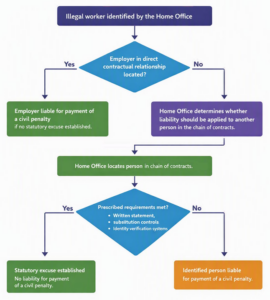
The draft also introduces extended liability – civil liability for a missing or incorrect Right to Work check may extend beyond the employer with the direct contractual relationship with the worker, covering third-party employers, online matching services, and situations where work may be substituted between several individuals.
Some things to note:
- ‘Extended liability’ does not automatically shift the responsibility for completing a Right to Work check onto someone further down the contractual chain.
- If the direct employer cannot be identified (e.g. the worker can’t identify who employs them, or records/contractual arrangements aren’t available), and the contractual employer is identified as having a responsibility, liability for not completing a Right to Work check may fall to them instead.
Full worked examples of extended liability, including a chain-of-contracts illustration, are set out in Section 3 of the current draft guidance. Several of the example titles were renamed in the September revision for clarity (for instance, ‘Food delivery’ is now ‘Substitution arrangements’ and ‘Purchasing labour indirectly’ is now’ Use of agency workers’) — the underlying scenarios and conclusions haven’t changed.
This illustration from the Home Office demonstrates where extended liability may apply:

The examples referenced in the green box can be found on pages 43 – 44 of the Employer’s guide to Right to Work checks draft.
The following image sets out the extended liability in a chain of contracts, and who may ultimately be found responsible and face civil penalty:
Who is not in scope?
Someone purchasing services or labour for their own, personal operations does not automatically bring them into the new extended liability regime. For example, the following groups of people would generally be exempt from extended liability:
- Self-employed tradespeople like plumbers or electricians
- Independent accountants
- Freelancers like graphic designers, trading through their own Ltd. company
- Businesses buying services for themselves
Establishing a statutory excuse for extended liability
In order to protect your business against extended liability claims, it’s important to complete these steps before work commences:
- Create a written statement setting out who is responsible for completing Right to Work checks, and establishing controls over further subcontracting.
- Establish substitution controls to ensure Right to Work checks are carried out on any substitute worker, where relevant.
- Have an identity-checking method in place to confirm the person turning up to work is the same person the Right to Work check was performed on. The guidance isn’t prescriptive about how to do this, but suggests workplace ID cards, periodic face-matching checks, or attendance management systems – with re-verification recommended at least once per shift or 24-hour period.
Three ways to conduct Right to Work checks
The three routes for completing a check haven’t changed, and the September draft confirms that carrying out the check itself can be delegated to staff acting on the employer’s behalf across all three methods – though the employer remains responsible for the outcome either way.
- Online checks: where an individual has an eVisa, use a share code and date of birth to check eligibility through the Home Office service and confirm the photo matches the applicant. Evidence of the check must be retained (access, check, record, store). Some DVSPs, including TrustID, integrate with the Home Office online checking service so employers can pull the report and complete the identity check by requesting a selfie to compare against the individual’s image.
- Manual checks: the employer (or a delegated member of staff) checks the worker’s original documents (obtain, check, copy, store).
- Checks using a Right to Work Digital Verification Service Provider (DVSP): a certified third party, registered with OfDIA and confirmed able to provide Right to Work checks, carries out the check on the employer’s behalf. From October, employers choosing the digital route must use a registered RtW DVSP appearing on the digital identity and attributes register – and if the check is bought through an intermediary rather than the DVSP directly, that intermediary must now clearly state which registered DVSP is actually doing the work.
In every instance, evidence must be recorded and retained for the duration of employment plus two years.
When a Right to Work check is completed, the employer will see whether the individual has a continuous or time-limited right to work. A continuous check usually means no follow-up checks are needed. A time-limited right to work means the employer will need to complete a follow-up check after a set period.
Reasons why an employer may lose their statutory excuse
Last year, the Home Office issued more than £130 million in fines from employers found to be using illegal workers. Civil penalties can reach up to £60,000 per illegal worker, and employers can face jail time of up to five years, or an unlimited fine depending on the severity of the offence. Illegal working arrests have risen significantly since 2022, and that figure is expected to climb further as these changes take effect.
You may lose your statutory excuse – and therefore face criminal or civil consequences – if:
- The Right to Work check was completed after employment began.
- The wrong method of checking was used.
- You relied on a share code without checking the underlying report.
- You failed to confirm that the person turning up for work is the person the check was carried out on. If you have doubts about someone’s identity or documents, the guidance now recommends raising these concerns with the individual directly, in a sensitive and proportionate way, rather than proceeding regardless.
Support from TrustID
As a certified Digital Verification Service Provider, TrustID are a leading and trusted provider of Right to Work checks, supporting thousands of employers across the UK with their hiring needs. We will keep you updated as this new draft is refined and completed. For now, if you would like to get ahead of the changes, simply get in touch with our expert team.
Sign up to receive updates
Receive notifications from TrustID direct to your inbox. Simply fill out your email address in the form below.
Want to find out more?
We’d be really happy to chat through your requirements and offer advice on the best service for your business.
Tel: 0118 466 0822 or email us.
Request a callback